09th December 2025
Allergy trends: How pharmacists can lead in the new era of allergy care
Read More >>

12th February 2026
Original article here
11 February 2026
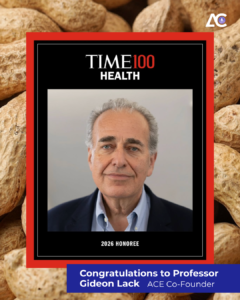
We are incredibly proud to share that Professor Gideon Lack, co-founder of the Allergy Centre of Excellence and Professor of Paediatric Allergy at King’s College London, has been named to TIME’s 2026 TIME100 Health list of the world’s most influential leaders in health.
The TIME100 Health spotlights 100 individuals whose work is shaping the future of health around the world. Professor Lack’s inclusion recognises a career dedicated to transforming how we prevent food allergies in children, and the real-world impact that work is having on families today.
For Professor Lack, the honour is inseparable from the families and the science that made it possible.
“When we began the LEAP study, the medical advice was to avoid giving peanuts to young infants in order to prevent peanut allergy. We showed the opposite was true,” Professor Lack said. “But research only matters if it reaches the families who need it.”
The landmark Learning Early About Peanut Allergy (LEAP) study, led by ACE founders, Professor Lack and Professor George Du Toit and published in the New England Journal of Medicine in 2015, provided the first robust evidence that introducing peanuts early in a child’s diet could reduce the risk of developing peanut allergy by up to 81%. The findings prompted a reversal of allergy prevention guidelines worldwide and reshaped how paediatricians, allergists, and parents approach early feeding.
Both Professors Lack and Du Toit, who serve as Directors of the Allergy Centre of Excellence, were instrumental in the design and delivery of the LEAP trial. That shared commitment to translating research into clinical practice sits at the heart of everything we do at ACE.
The impact of that work continues to grow. A 2025 study from the Children’s Hospital of Philadelphia (CHOP) used electronic health records to demonstrate that since the implementation of early-introduction guidelines, clinical rates of peanut allergy in infants may have fallen by 43%.
“The CHOP study suggests that for every 200 infants who follow these early introduction protocols, one child is saved from a lifelong food allergy,” Professor Lack noted. “We aren’t just managing allergies anymore; now we are actively preventing them.”
Beyond the research, Professor Lack remains a practising clinician. Together with Professor Du Toit and Professor Adam Fox OBE, he co-founded the Allergy Centre of Excellence to ensure that the insights gained from decades of research reach the families who need them most.
At ACE, our team works directly with families navigating the full spectrum of childhood allergies, from eczema and food allergy in infants to complex multi-allergen cases in older children. The centre specialises in the care of children from birth, offering allergy testing, diagnosis, and advanced treatment including oral immunotherapy and early allergen introduction protocols.
“The allergy epidemic is one of the defining public health challenges of our time,” Professor Lack said. “What we’ve learned is that we can intervene early. We can change the trajectory for children. That is what drives everything we do.”
The LEAP study demonstrated an 81% reduction in peanut allergy among high-risk infants who consumed peanut early. Current estimates suggest that for every 200 infants who follow early introduction guidelines, one case of food allergy may be prevented.
ACE Managing Director Chloe Eburn adds, “𝑨𝒔 𝒂 𝒍𝒆𝒂𝒅𝒆𝒓𝒔𝒉𝒊𝒑 𝒈𝒓𝒐𝒖𝒑, 𝒂𝒏𝒅 𝒂𝒍𝒐𝒏𝒈 𝒘𝒊𝒕𝒉 𝒕𝒉𝒆 𝒘𝒊𝒅𝒆𝒓 𝒕𝒆𝒂𝒎 𝒉𝒆𝒓𝒆 𝒂𝒕 𝑨𝑪𝑬, 𝒘𝒆 𝒂𝒓𝒆 𝒕𝒉𝒓𝒊𝒍𝒍𝒆𝒅 𝒕𝒐 𝒔𝒆𝒆 𝑮𝒊𝒅𝒆𝒐𝒏 𝒉𝒐𝒏𝒐𝒖𝒓𝒆𝒅 𝒊𝒏 𝒕𝒉𝒆 𝑻𝑰𝑴𝑬 100 𝑯𝒆𝒂𝒍𝒕𝒉 𝑳𝒊𝒔𝒕. 𝑯𝒊𝒔 𝒘𝒐𝒓𝒌 𝒊𝒏 𝒕𝒉𝒆 𝒂𝒍𝒍𝒆𝒓𝒈𝒚 𝒇𝒊𝒆𝒍𝒅 𝒉𝒂𝒔 𝒃𝒆𝒆𝒏 𝒍𝒊𝒇𝒆 𝒄𝒉𝒂𝒏𝒈𝒊𝒏𝒈 𝒇𝒐𝒓 𝒔𝒐 𝒎𝒂𝒏𝒚, 𝒂𝒏𝒅 𝒘𝒆 𝒂𝒓𝒆 𝒆𝒙𝒕𝒓𝒆𝒎𝒆𝒍𝒚 𝒑𝒓𝒐𝒖𝒅 𝒕𝒐 𝒘𝒐𝒓𝒌 𝒂𝒍𝒐𝒏𝒈 𝒔𝒊𝒅𝒆 𝒉𝒊𝒎 𝒊𝒏 𝒕𝒉𝒊𝒔 𝒇𝒊𝒆𝒍𝒅. 𝑪𝒐𝒏𝒈𝒓𝒂𝒕𝒖𝒍𝒂𝒕𝒊𝒐𝒏𝒔, 𝑮𝒊𝒅𝒆𝒐𝒏”.